
Phase 1
From vision to action
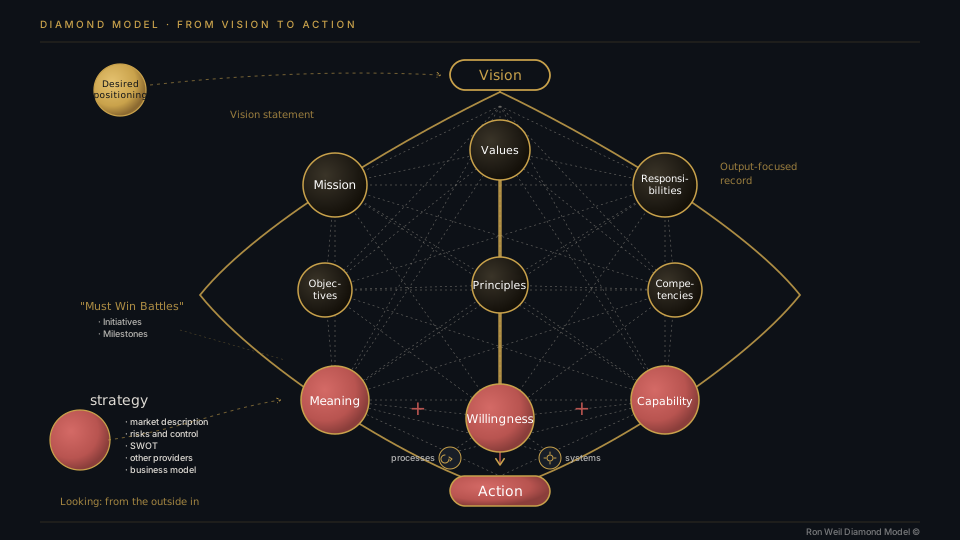
The Diamond Model as the frame. Mission, values, responsibilities. And the three carriers on which execution depends: meaning, willingness, capability.
Others deliver a strategy. This course delivers movement.
A strategy document alone does not change behaviour. And without behaviour change there is no execution. For boards, executives, business owners, family businesses and teams who know that the next step also has to be taken in practice.
If you want your vision to be carried, your people must answer three questions positively.
“Do I see the point of this?”
“Am I willing to cooperate?”
“Can I actually do it?”
These three carry every execution. If one is missing, it stays at nodding. This course works on all three.
The Diamond Model as the frame. Mission, values, responsibilities. And the three carriers on which execution depends: meaning, willingness, capability.
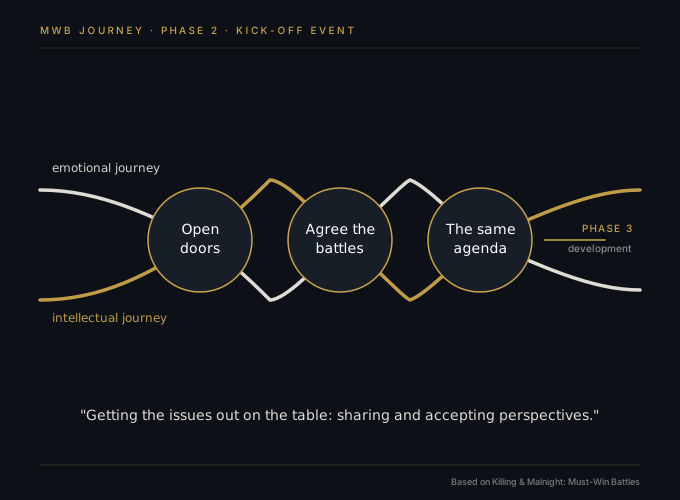
Two days. The participants together. The emotional and intellectual journeys run in parallel towards three to five must-win battles that the participants genuinely own.
As soon as possible after the kick-off, sometimes in parallel. Per battle: who, what, when. Compact and usable.
Three to six months of guidance for the participants who lead a battle. Confidential. Short. Direct.
After half a year, the balance. What is moving, what needs recalibrating, what calls for a second cycle.
Execution does not happen by itself. Meaning, willingness and capability carry every step. Where one of the three falters, the organisation stays stuck, and the Diamond Model makes this visible.
Tap to enlarge
The Diamond Model: from vision to action through three carriers and three levels.
Two journeys run in parallel through the kick-off: the intellectual journey (which battles to win) and the emotional journey (what are we prepared to ask of each other). Where the two meet, a shared agenda emerges.
Tap to enlarge
Open doors, setting the battles, the same agenda: the three moments in the kick-off where head and heart come together.
The MWB approach goes back to the work of Peter Killing and Thomas Malnight (Must-Win Battles). They make visible which three to five battles decide whether you win in the coming years. Focus instead of scattering.
The Diamond Model is the addition where the MWB method stops. Killing and Malnight describe which battles to fight. The Diamond Model makes sure those battles also land in behaviour, through meaning, willingness and capability.
This journey combines both, and that is what separates a strategy document from movement in the organisation.
For boards, executives and teams who know that plans alone no longer work. For business owners who want their people to become co-owners of the course. For executives in transition who want the new direction to really land in behaviour.
The first step is always an exploratory conversation. Confidential. With no obligation to continue. If there is value, we build on it. If there is no match, we stop.
Book an exploratory conversationRon J.C. Weil, Business & Executive Coach. Email: ron@ronweil.nl · Phone: +31 6 47 86 47 07
This website uses Google Analytics 4 to gain anonymised insight into website visits, such as page views and where visitors come from. Google Analytics is set up with privacy in mind: IP addresses are not stored, Google Signals and ad personalisation are switched off, and the data is not used for advertising. If you contact me by email or WhatsApp, I process only the information you give me yourself.
I use contact details only to answer your question or to follow up on your request, and I do not share them with third parties. Visit statistics are used only to improve the website. Google processes these statistics as a data processor; see Google's privacy policy.
You have the right to access, correct or delete your data via ron@ronweil.nl. You can also lodge a complaint with the Dutch Data Protection Authority (Autoriteit Persoonsgegevens).
Cookies are small text files that are stored on your device when you visit a website.
This website uses analytical cookies from Google Analytics 4 (cookies that start with _ga). These cookies give anonymised insight into how the website is used. Google Analytics is set up with privacy in mind: IP addresses are not stored, and the data is not used for advertising or for following visitors across other websites. No tracking or marketing cookies are used.
You can delete or block cookies at any time in your browser settings. This does not affect how the website works. You can also switch off measurement by Google Analytics through Google's opt-out.
These terms apply to all offers, assignments and agreements of Ron J.C. Weil.
Not included in the fee: VAT (21%), travel costs (€ 0.55/km), and accommodation costs where necessary. Assessment instruments and psychometric tools are quoted separately.
We are fully committed to the confidentiality of our participants and clients.
Changes must be notified at least two weeks in advance. After that, 50% of the daily fee will be charged.
If an open workshop does not go ahead, for example because of too few registrations or because I am unable to hold it, we will offer a new date or refund the amount paid.
We accept no liability for damage caused by participants or clients. Where we are liable, this is limited to the fee invoiced for the assignment concerned. This limitation does not apply in cases of intent or deliberate recklessness.
This agreement is governed by Dutch law. Disputes will be submitted to the competent court in the Netherlands. If the Dutch and English versions differ, the Dutch version prevails.
Invoices are usually sent four weeks before the start. The full invoice amount (100%) is due on the first invoice date. Payment must be made within 14 days of the invoice date. In case of late payment, statutory interest is due.
Private individuals who order the book can cancel within 14 days of receipt without giving a reason. The book is then returned unused, and the cost of returning it is borne by the buyer. We refund the amount paid, including standard shipping costs, within 14 days of receiving the returned book.